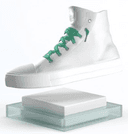






Image Upload
Image upload personalization allows users to add custom brand logos, graphics, or photographs projected dynamically onto 3D product surfaces.
TL;DR#
Image upload personalization lets customers upload, position, scale, and preview custom brand logos or photographs on 3D product surfaces before purchasing.
Modern 3D web configurators project customer uploads onto product meshes using Three Shading Language (TSL) texture samplers, composite multiple decal zones onto an offscreen plane atlas to optimize GPU memory, and serialize media references for instant sharing and e-commerce cart line-item orders.
Definition#
Physical image upload personalization is the process of transferring, printing, or applying dynamic customer-supplied graphics, brand logos, or personal photographs onto a product surface.
In digital e-commerce, image upload personalization refers to real-time 3D visual previews that project uploaded bitmap or vector images directly onto virtual product surfaces, adjusting for lighting, geometry, and perspective.
While physical manufacturing relies on screen printing, direct-to-garment (DTG), vinyl transfers, or UV printing, interactive 3D visual previews project these assets dynamically using graphics shading language samplers before generating production-ready print files.
Why It Matters#
Retailers offering real-time graphic upload personalization report increases in purchase confidence and order volume, as measured in customer deployment benchmarks.
Interactive graphic projection transforms standard e-commerce products into personalized merchandise, driving average order value growth and reducing pre-purchase uncertainty.
Providing an accurate real-time 3D preview of custom uploaded logos mitigates product return liabilities by ensuring visual alignment prior to manufacturing.
According to research by IPSOS, over 80% of online shoppers report that interactive 3D visualization directly influences their purchasing decisions when buying customized merchandise.
“Adding dynamic logo and sticker uploads to our water bottle configurator reduced customer bounce rates from 64.7% down to 21.9% and doubled online conversion rates within 30 days of launch.”Peter Arlein, Founder of mountainFLOW
Technical Alternatives#See More→
Flat 2D Canvas Photo Overlay#
Flat 2D canvas photo overlay renders dynamic customer logos as flat image tags layered on top of standard product photographs.
Flat 2D canvas photo overlay is a correct choice for simple, flat surfaces like custom banners or flat signs where three-dimensional perspective, material lighting depth, and camera rotation are unnecessary.
However, flat 2D canvas photo overlay fails for 3D and augmented reality configurations because it cannot wrap textures around curved objects, does not reflect environmental lighting, and cannot adapt to model rotation.
Pre-rendered Variant Texture Libraries#
Pre-rendered variant texture libraries load and swap predefined, high-resolution textures baked by artists during product design.
Pre-rendered variant texture libraries are a correct choice for curated catalog selections, branded collections, or stock graphic options where users do not need to upload arbitrary personal files.
However, pre-rendered variant texture libraries fail for direct custom image personalization because they cannot support arbitrary user uploads and incur a combinatorial file size explosion if multiple customization zones are offered.
Server-side Texture Baking & Composite Processing#
Server-side texture baking composites dynamic logo overlays and processes color mappings on remote workers, returning flat baked images to the client.
Server-side texture baking is a correct choice for high-fidelity manufacturing outputs or print-ready file preparation where precision and vector resolution are required.
However, server-side texture baking fails for real-time 3D configurator previews because network roundtrip latency prevents interactive adjustments during logo scaling or rotation.
Engineering Challenges#See More→
Implementing dynamic 3D decal projection requires resolving severe browser GPU resource limits, main-thread render stalls, and coordinate projection artifacts.
Each mitigation detailed below — VRAM resource cleanup, asynchronous GPU queueing, UV-aware wrap geometry, adaptive vector rasterization, and depth-offset handling — is automated inside the Aircada rendering engine to eliminate custom graphics engineering overhead.
Dynamic Canvas Memory Bloat#
Dynamic configurators allowing users to upload custom images must manage graphics card memory allocation carefully during active customization sessions.
When a user uploads a new image, the browser decodes it and transfers the pixel payload to GPU memory as a texture resource.
Assigning a new image source to a material map property triggers a GPU texture re-upload on the next render call, but the GPU-side buffer for the previous texture object remains allocated — the JavaScript garbage collector has no visibility into GPU-side VRAM.
If the user changes images repeatedly or updates scale and position coordinates rapidly, VRAM usage accumulates, causing mobile browser tab reloads or GPU device lost errors — the leading cause of abandoned customization sessions on mobile WebKit.
To mitigate VRAM accumulation, the engine explicitly releases old texture buffer references from GPU memory before binding new asset descriptors.
“In the Koko Art Shoes interactive customizer, rapid user uploads of custom logo variations on older mobile devices caused Safari to crash due to VRAM leak accumulation. Implementing a short input debounce and calling explicit VRAM release methods on previous texture descriptors during updates eliminated context crashes entirely.”Sean Chenoweth, Co-founder
Synchronous Upload Latency#
In WebGL-based engines, transferring pixel data from a dynamic canvas or HTML image element to the GPU blocks the CPU main thread synchronously.
While the GPU compiles and binds the texture payload, the browser main thread halts, resulting in dropped frames and visual stutter during user interactions like logo scaling or position adjustments.
WebGPU resolves main-thread blocking by utilizing asynchronous device queue transfer commands that operate independently of CPU execution.
Asynchronous GPU buffer transfers allow the browser engine to copy decoded image data directly to GPU memory in the background without interrupting UI responsiveness.
Dynamic uploads under WebGPU still incur bind group and sampler descriptor recreation overhead, requiring short input debouncing to prevent pipeline compilation lag during rapid adjustments.
“Moving dynamic texture uploads to asynchronous GPU queue transfers reduced frame drops during live logo adjustments, maintaining a smooth 60 FPS user experience.”Wylie Chenoweth, CTO
Decal Aspect Ratio Stretching#
Projection shaders default to evaluating texture coordinates on a standardized square grid.
When users upload non-square artwork, mapping texture coordinates directly causes the image to stretch or squash across the projection surface.
To prevent distortion, the rendering engine evaluates the dimensional aspect ratio of the uploaded image file prior to GPU texture binding.
Using this aspect ratio, the shader scales the texture coordinate projection matrix proportionally, preserving the original artwork proportions.
Proportional scale factors adjust horizontal and vertical texture boundaries dynamically, maintaining correct graphic proportions across all model orientations.
“In the MountainFlow water bottle project, dynamic aspect ratio correction in the shader was critical. Without it, rectangular sponsor logos projected onto cylindrical bottles appeared distorted, prompting user complaints and design errors.”Wylie Chenoweth, CTO
SVG Vector Rasterization & Pixelation#
Vector graphics format uploads, such as SVG, are resolution-independent but cannot be mapped directly as GPU textures without rasterization.
WebGL and WebGPU shaders sample from a rasterized pixel grid, requiring vector files to be drawn to an offscreen canvas element before GPU transfer.
If vector files are rasterized to a static canvas size on initial load, the projected decal becomes blurry or pixelated when the user zooms in close to the 3D model.
To resolve blurriness, the system detects camera zoom transitions and re-rasterizes the vector source to a high-DPI canvas matching the physical pixel density of the viewport.
Viewport-aware vector re-rasterization is throttled during active camera movements to maintain consistent frame rates while updating GPU texture memory.
“For a corporate drinkware client, sponsor logos with fine text became illegible when users zoomed in. Throttling dynamic vector canvas redraws during camera transitions kept fine lines sharp without degrading frame rates.”Wylie Chenoweth, CTO
UV Seam Splitting & Filtering Seams#
Projection-based decals rely on continuous UV coordinate spaces to display textures without disruption.
On complex 3D meshes, UV maps are cut into separate islands to minimize geometric distortion on curved surfaces.
If a user drags a decal across a discontinuous UV island seam, the texture splits, projecting separate parts in unrelated mesh zones.
UV seam fragmentation is resolved by implementing triplanar shader projection mapping or utilizing dedicated invisible wrap meshes designed with continuous UV coordinates.
In cylindrical product configurations, continuous wrap geometries map composite sticker texture sheets cleanly around the model body without splitting seams.
“When testing full-bleed decals on complex footwear models, raw UV maps caused logos to fragment across outsole joints. Projecting decals onto an independent, continuous wrap shell eliminated seam splitting completely.”Wylie Chenoweth, CTO
Z-Fighting & Decal Z-Offsets#
Applying a dynamic decal using an independent wrap mesh places two surfaces in extremely close spatial proximity.
Z-fighting flicker results from finite depth buffer precision combined with non-linear depth distribution from perspective projection, leaving the GPU unable to determine which surface is in front.
Z-fighting flicker is exacerbated at glancing camera angles on mobile GPUs operating with 16-bit depth buffers compared to desktop 24-bit or 32-bit buffers.
To resolve depth conflicts, the engine applies a localized vertex displacement along the surface normal or configures material depth offset parameters in the GPU rasterizer.
Material depth offsets shift rasterization calculations in GPU memory, rendering decal wrap meshes consistently in front of base product surfaces.
“On mobile browsers, glancing views of bottle labels flickered intensely. Applying a localized vertex displacement along the normal vector solved the depth conflict cleanly without creating floating artifacts.”Wylie Chenoweth, CTO
Real-world Examples#
Dynamic image upload personalization is deployed across promotional drinkware, custom athletic footwear, and gaming accessories to offer instant 3D product customization previews.
- mountainFLOW Custom Water Bottle: Projects corporate PNG/SVG logos and sponsor stickers onto insulated steel hydration bottles with real-time background removal and color palette matching.
- Koko Shoes Personalizer: Maps custom uploaded graphic decals and vector artwork onto shoe quarter panels and outsole components.
- Bivo Hydration Bottle Configurator: Projects high-resolution sponsor branding onto stainless steel athletic bottles.
- Cinch Gaming Custom Controller: Fits custom logo uploads and vinyl branding graphics onto pro gaming controller housings.