




Case study
Sustainable D2C & B2B
How mountainFLOW decreased bounce rate by 66.15% with a custom bike bottle product configurator
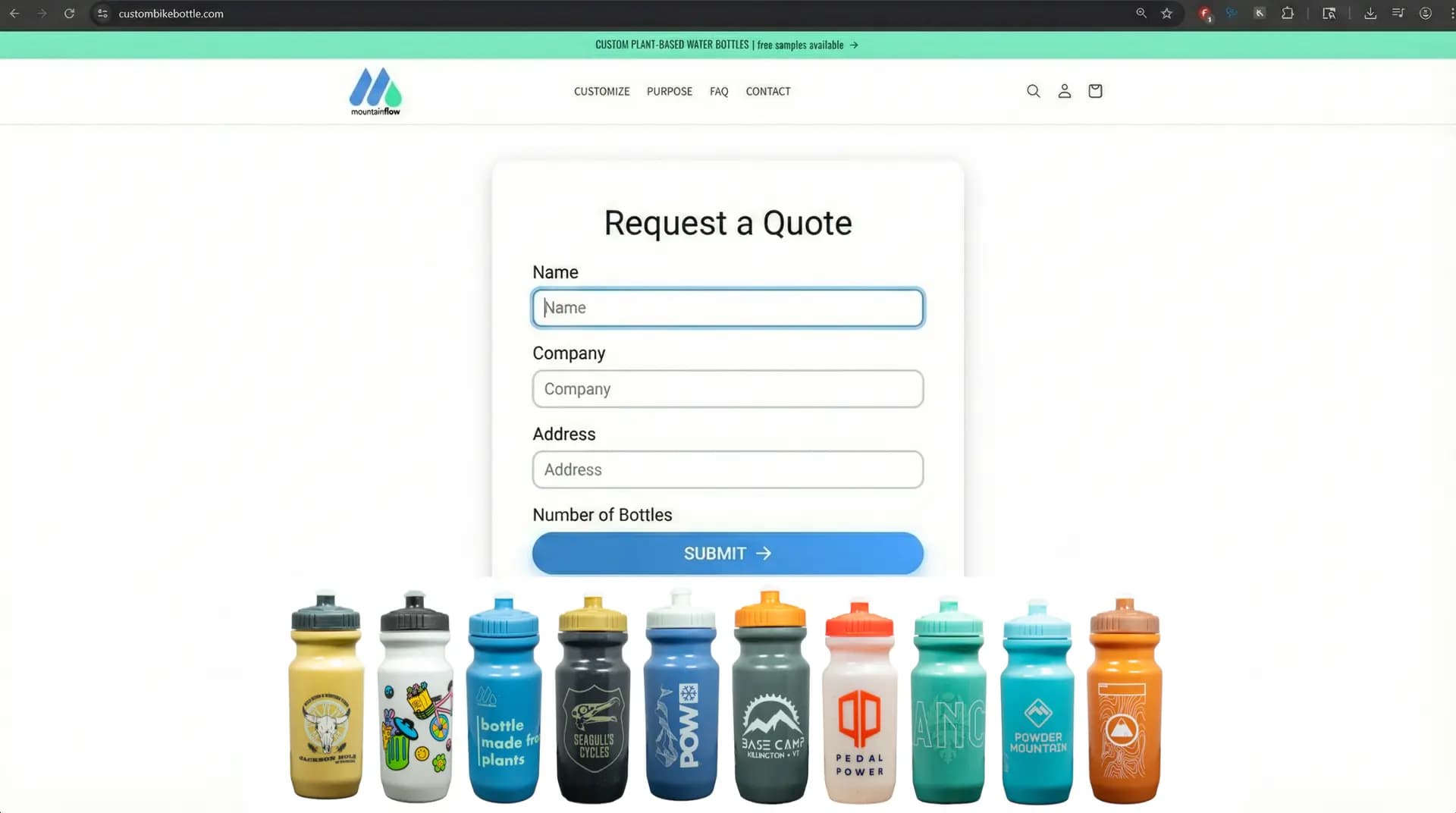
So long "Request a Quote" Button. Do close the door on the way out.
Mountain Flow has the 'Shark Tank' fame, the cult following, products of such quality we have no idea how they do what they do, and one of the most likable founders around. But their blind inquiry process was torching high-value leads.
The "Before" times
Let’s get one thing straight: Mountain Flow's existing brand already had a cult-like following. That makes our job a lot easier. (Thank you, Peter). He is one of the most genuinely likable founders we’ve ever met. They went on Shark Tank, crushed it, and built a following that most B2B brands would kill for.
Visually? Their site is stunning. The UI was polished. The brand vibe was immaculate.
And Peter wasn't afraid to be the poster child of the custom bike bottle product line.

But here is the hard truth: Brand love would not save a static "Request a Quote" style form.
Despite the hype and the beautiful interface, their actual conversion mechanism wasn't primed like their eco-friendly ski wax product line. It was a static, blind inquiry form sitting at the bottom of a beautiful page. All that brand heat was funneling down to a "Request a Quote" button which was awfully anti-climactic.
"We had eyeballs. We had fans. But we were seeing a 64.7% Bounce Rate on this specific product page. People would look, get excited, see the form, get anxious about the complexity and investment of time, then leave."
— Brian Gallagher, COOThis created a massive operational bottleneck. Even when a "fan" did convert, the sales team wasn't just selling; They were chasing EPS files and explaining to grown adults why a low-res JPEG won't print well on a curved industrial cylinder.
By the time the team secured a printable asset, the customer’s excitement could wane, and certain deals would go cold.
It was time to take the "Request a Quote" button out behind the barn. Unlike Old Yeller, it would likely not be missed.
The Pivot: The Trojan Horse Strategy
Here is where most agencies get it wrong. They scream, "Let's add e-commerce! Let's make it instant buy!"
We avoided this temptation.
Based on the nature of Mountain Flow's fulfillment—complex bulk orders, freight shipping to obscure zip codes, and fluctuating material costs—we couldn't do an instant cart checkout. We needed a quote request. We needed the form data.
So, we didn't kill the form. We stuffed it within a fun, easy-to-use design tool.
We built a custom WebGPU Configurator. It looks like a fun design tool, but functionally, it's an aggressive lead capture form. We kept the input fields—Quantity, Zip Code, Name, Email—but we moved them inside the visual experience.
Instead of "Fill this out so we can call you," the psychology shifts to "Customize your product, and fill this out to save your creation."
We are leveraging the Sunk Cost Fallacy. If a user spends 5 minutes dragging logos, adjusting colors, and perfecting their cylinder, they are psychologically committed to that design. They will give you their email address to save it.
Real-time Warp Logic: The configurator detects cylinder curvature and wraps the 2D asset automatically.
UX Deep Dive: Solving the "Cognitive Tunnel"
Designing a contact form is easy. Designing a dynamic configurator that handles complex industrial variables on a shattered iPhone screen made us question our life choices on a few occasions. We had to manage a massive amount of logic without overwhelming the user.
The Mobile vs. Desktop Split
We realized early on that a responsive single layout is a myth. It never works for more complex apps.
- On Desktop: We used an expandable "Accordion" system. Only one section opens at a time (e.g., Size, Logo, Color). This forces focus. You can't worry about the shipping zip code while you're still deciding on the bottle color.
- On Mobile: Accordions took up too much vertical real estate. We switched to a Tab-based system at the bottom of the viewport, keeping the 3D model fixed in the center so the user's thumb never blocks the product.
The Logic Nightmare (Handled Gracefully)
This wasn't just "upload a logo." The form had to mutate based on the bottle selection. If we showed every option at once, the user would bounce immediately.
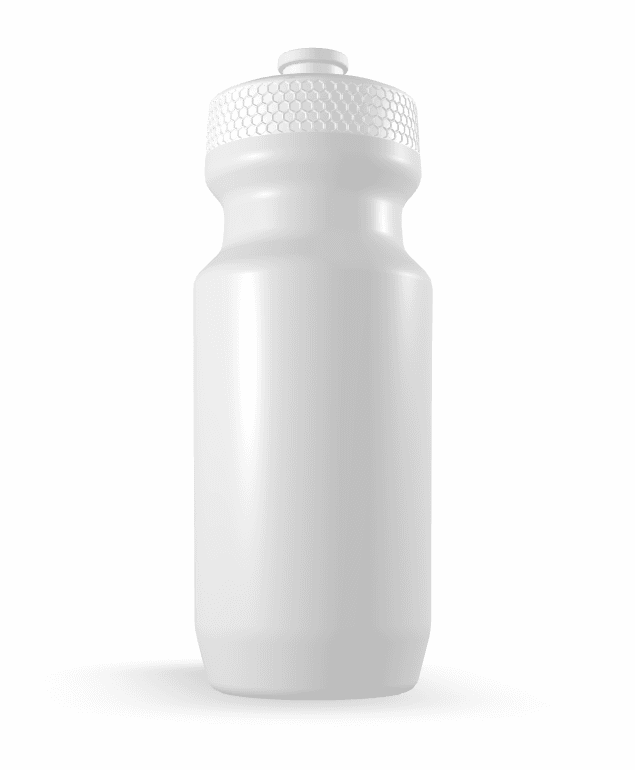
600ml Bottle
Simple Logic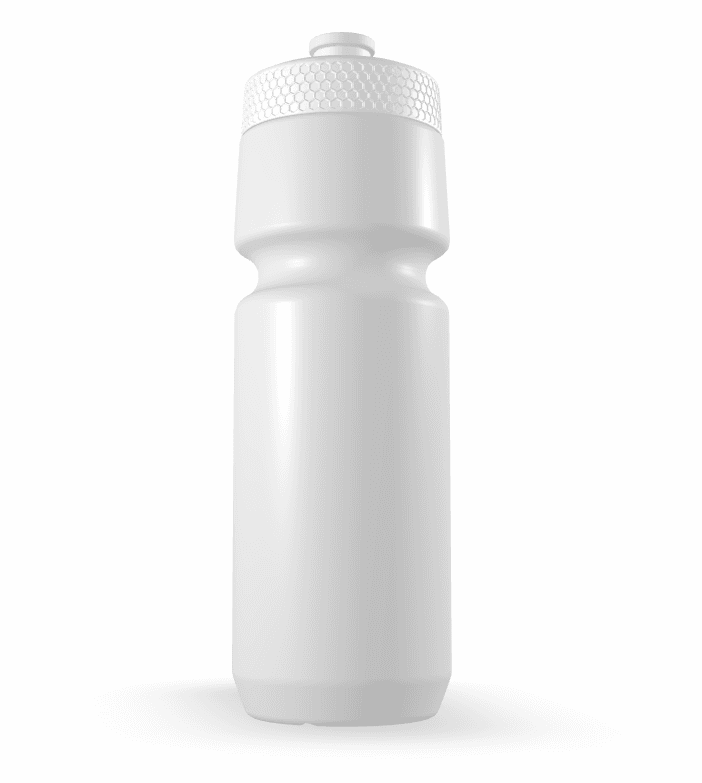
700ml Bottle
ChaosWe built a dynamic rendering engine for the inputs. If you click "700ml," the uploader array instantly regenerates to show four distinct dropzones (Front Base, Front Neck, etc.). If you switch back to "600ml," it cleans itself up.
The Result: By the time the user gets to the final "Details" tab to enter their name and email, they aren't filling out a cold form. They are saving a product they have spent 5 minutes perfecting. They are already sold.
Under the Hood: WebGPU & The "No-Node" Stack
The most common objection to 3D on the web is: "It will load like a brick."
That is only true if you bloat your stack with unnecessary libraries because you're too lazy to write optimized code. We didn't use standard WebGL wrappers that choke the main thread. We built this on WebGPU (the successor to WebGL) for bare-metal performance, accessing the GPU directly for smoother frame rates even on mid-tier mobile devices.
- The Asset Pipeline
We used Draco Compression to shrink 40MB raw CAD files down to ~ 200 KB web-ready assets without losing the visual fidelity of the texture grain. It's the difference between a 10-second load time and an instant one.
- Performance Metrics
LCP (Largest Contentful Paint): Remained under 2.5s. The 3D viewer initializes after the critical rendering path, ensuring Google SEO bots see a fast, text-rich page.
The Results: 2.1x Lift in "Real" Revenue
We fixed the Leakage Bucket.
Traditional forms capture everyone, including the tire kickers who just want to see if you're cheaper than Alibaba. Our configurator acts as a filter. If a user isn't serious enough to engage with the tool for 30 seconds, they aren't worth the sales team's time.
Conversely, users who spent over 2 minutes in the tool had an intent signal so high it was practically a guaranteed close.
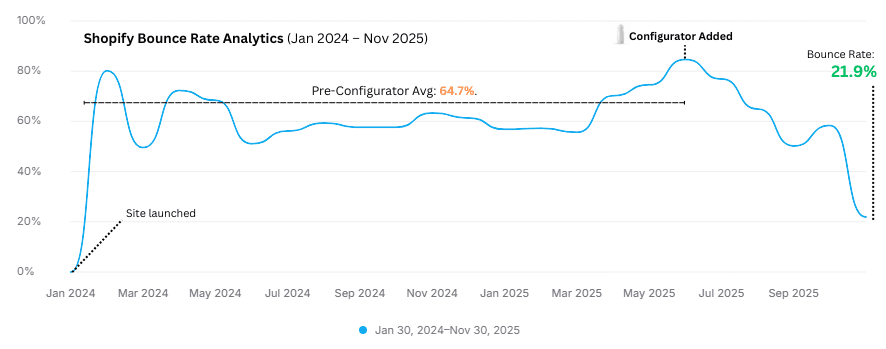
Dropped from a 64.7% average down to 21.9% immediately post-launch.
Reduction in pre-sales graphic design hours. The robot does the work.
Attributed directly to high-fidelity proofing and reduced friction.
The "Sticky" Factor: Crushing the Bounce Rate
The most telling metric wasn't just revenue; it was engagement. For nearly a year, the product page averaged a 64.7% bounce rate. Users landed, saw a static form, and left.
The moment the configurator went live (marked on the graph below), the page stopped being a "brochure" and became a "tool."
Source: Shopify Analytics (Jan 2024 – Nov 2025)
The bounce rate plummeted to 21.9%. While the immediate impact is undeniable, we believe in radical transparency regarding data.
To be fair, a 21.9% bounce rate is exceptionally low for any D2C page, and we are cautious about calling this the "permanent new normal" just yet. There is likely some noise in the initial post-launch window, and we expect some regression to the mean as the novelty wears off.
However, even if the rate stabilizes closer to 30-35% over the next few quarters, it still represents a massive improvement over the previous ~65% baseline. We will continue to monitor the long-tail data to filter out any seasonal anomalies.
Operational Impact: "We Got Our Fridays Back"
The most underrated ROI of spatial commerce is employee retention. Nobody wants to be a copy-paste robot.
Prior to this integration, Mountain Flow's designers were bogged down by "Inbox Ping Pong"—emailing clients to ask for different file formats or placement clarification. It was death by a thousand paper cuts.
Now, the customer "Self-Proofs." They see the color clash inside the browser. They see that the logo looks weird on the neck inside the browser. By the time they hit submit, they have approved their own work.
What’s Next: From Lead-Gen to Direct-to-Production
We aren't done. The next phase involves removing the human "Check" entirely.
We are currently building middleware that takes the 3D coordinates from the user's WebGPU session and automatically generates a print-ready PDF for the factory floor.
Zero-Touch Customization will make everyone involved smile. The customer designs it, the server vectors it, and the machine prints it. No humans required.
But for now, we'll be throwing back a few cold ones with Peter and Brian and saying our condolences to ol' "Request a Quote" button that we took out behind the barn and put to rest. Unlike Old Yeller, you will likely not be missed.
Technical Glossary
- WebGPU
- The next-generation graphics API for the web, allowing for more complex geometry and better performance than WebGL by accessing the GPU more directly.
- Cognitive Friction
- The mental effort required by a user to complete a task. In B2B, high friction (imagining the product) leads to abandoned carts.
- Draco Compression
- An open-source library for compressing and decompressing 3D geometric meshes. Essential for fast web load times.