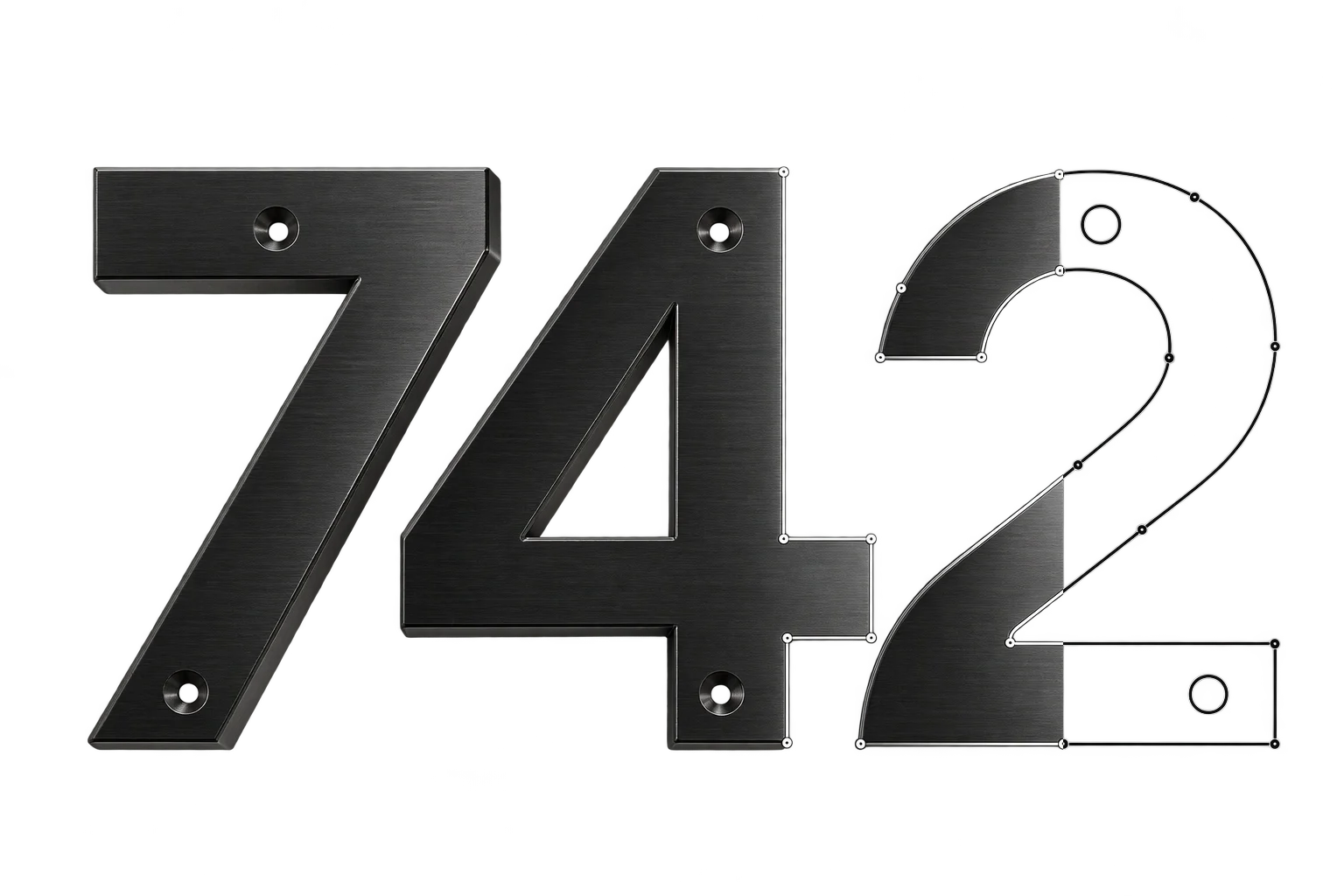
Made-to-measure 3D sizing with true-scale textures
Scaling a static 3D mesh along one axis stretches woodgrain textures, warps corner fillets into ovals, and distorts hardware proportions. Aircada rebuilds parametric primitives and rounded enclosures directly in the browser with arc-length UV calculation so textures and bevels stay accurate across any customer dimension.
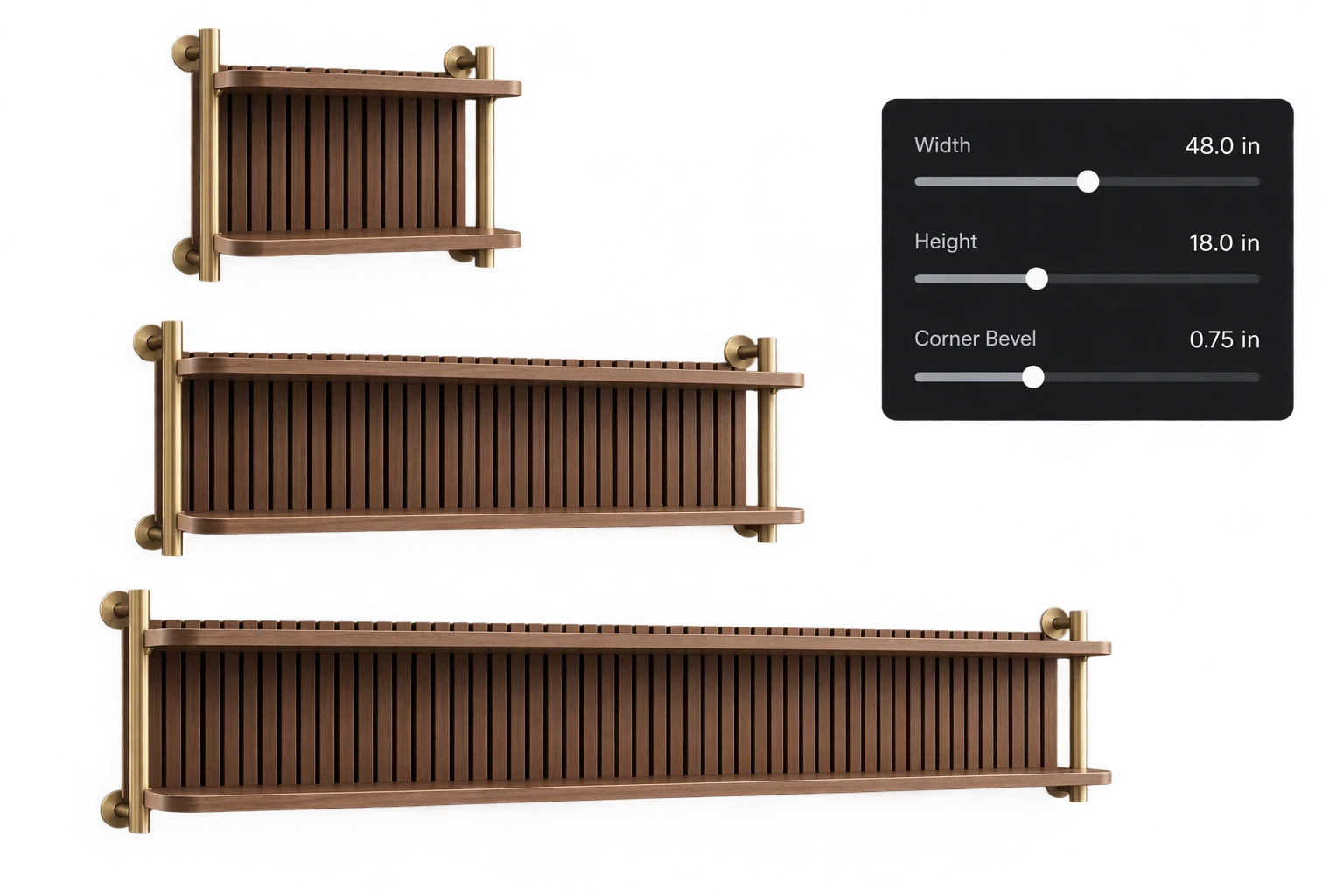
Stretching static 3D assets distorts bevels and grain
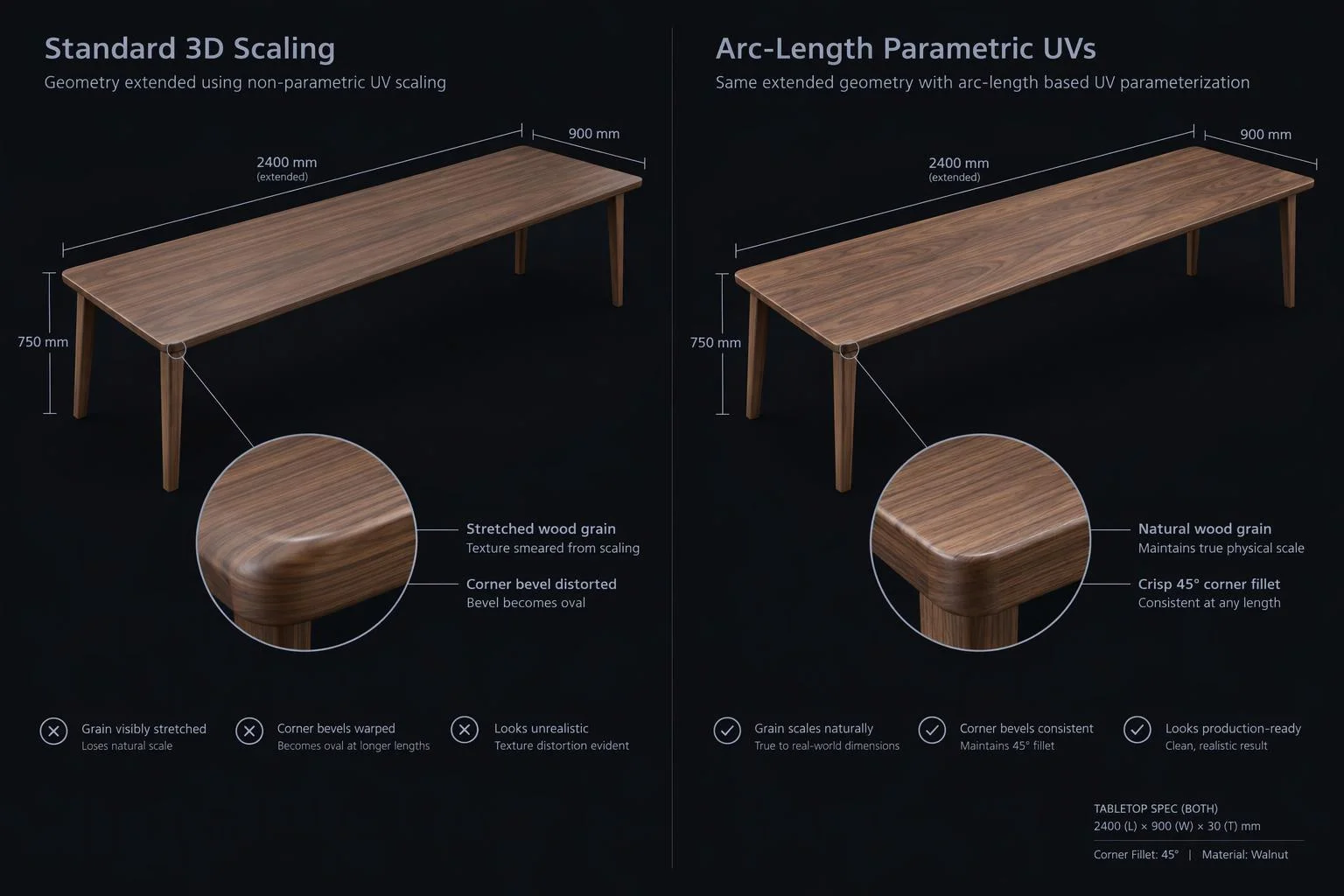
When a furniture maker, glazing fabricator, or industrial enclosure supplier sells products by the inch or millimeter, pre-modeling every possible width and height combination is impossible. Yet applying a standard X/Y/Z scale transform to a static 3D mesh immediately ruins the visual preview: a rounded corner chamfer stretches into a flattened slope, circular profiles deform into ovals, and wood or brushed-metal textures smear across the surface.
Aircada solves this with procedural 3D shape generation right inside the browser viewport. Instead of stretching a baked asset, the engine recomputes vertex positions, normal vectors, and arc-length UV parameterization on the fly whenever a shopper moves a dimension slider, while feeding those exact width, height, and depth values into live square-foot or volume pricing and writing verified fabrication measurements straight onto Shopify or headless checkout orders.
Parametric rounded enclosures and ten built-in shape primitives
Build custom-sized panels, tabletops, columns, and architectural components directly from dimensional parameters without pre-exporting hundreds of static 3D files.
Filleted Panels & Rounded Enclosures
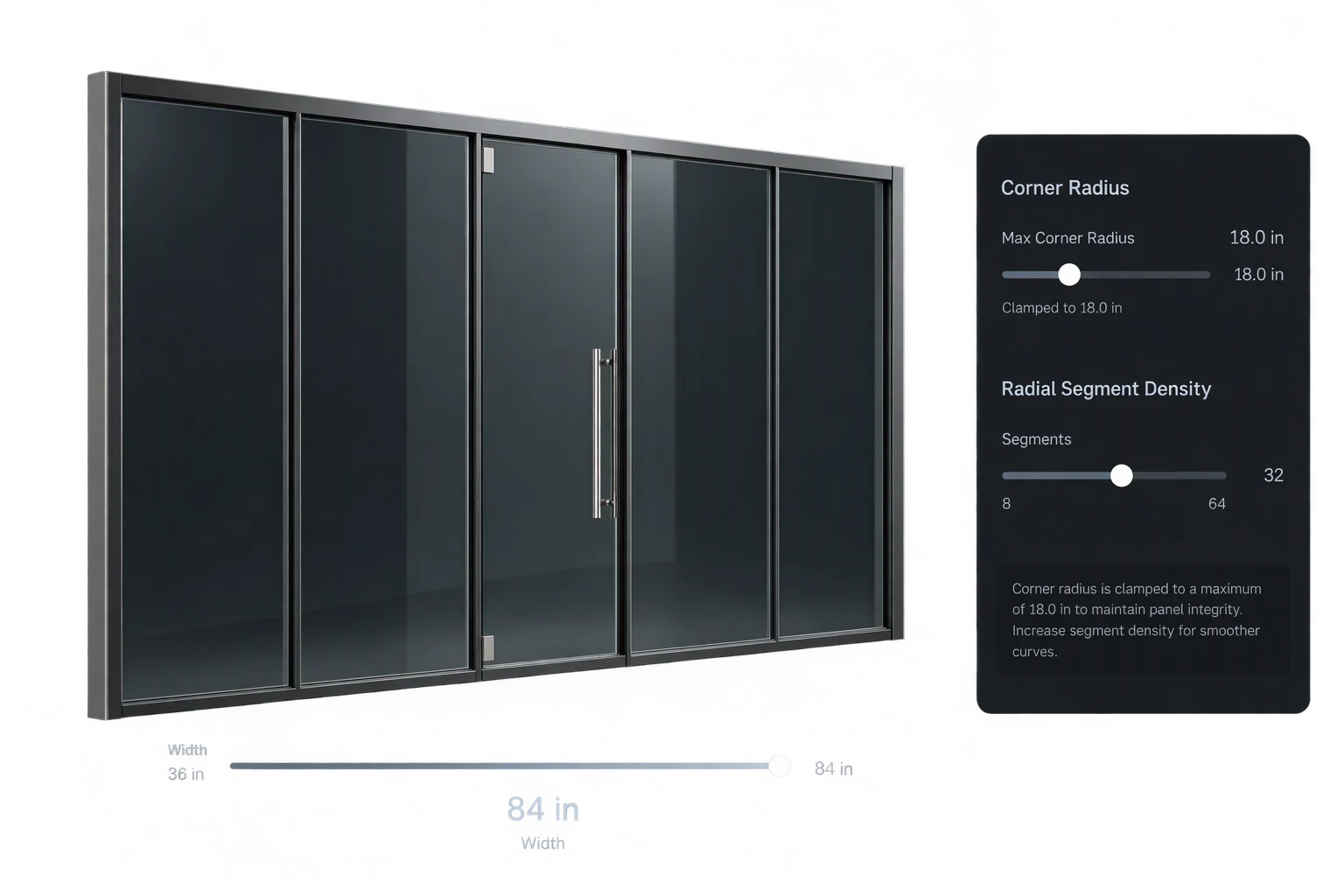
Generate rectangular panels, countertops, and enclosures with uniform or independent X, Y, and Z corner radii. As width, height, or depth changes, flat spans expand smoothly while scale-compensated corner fillets keep their exact circular profile.
- Set equal X, Y, and Z edge radii for uniform fillets or independent per-axis profiles
- Arc-length UV calculation integrates distance across flat faces and quarter-circle corner arcs so grain never pinches
- Automatic per-axis radius clamping limits every bevel to half of the shortest active side to prevent inverted faces
- Odd-segment bevel subdivision guarantees clean flat spans connecting opposing rounded edges
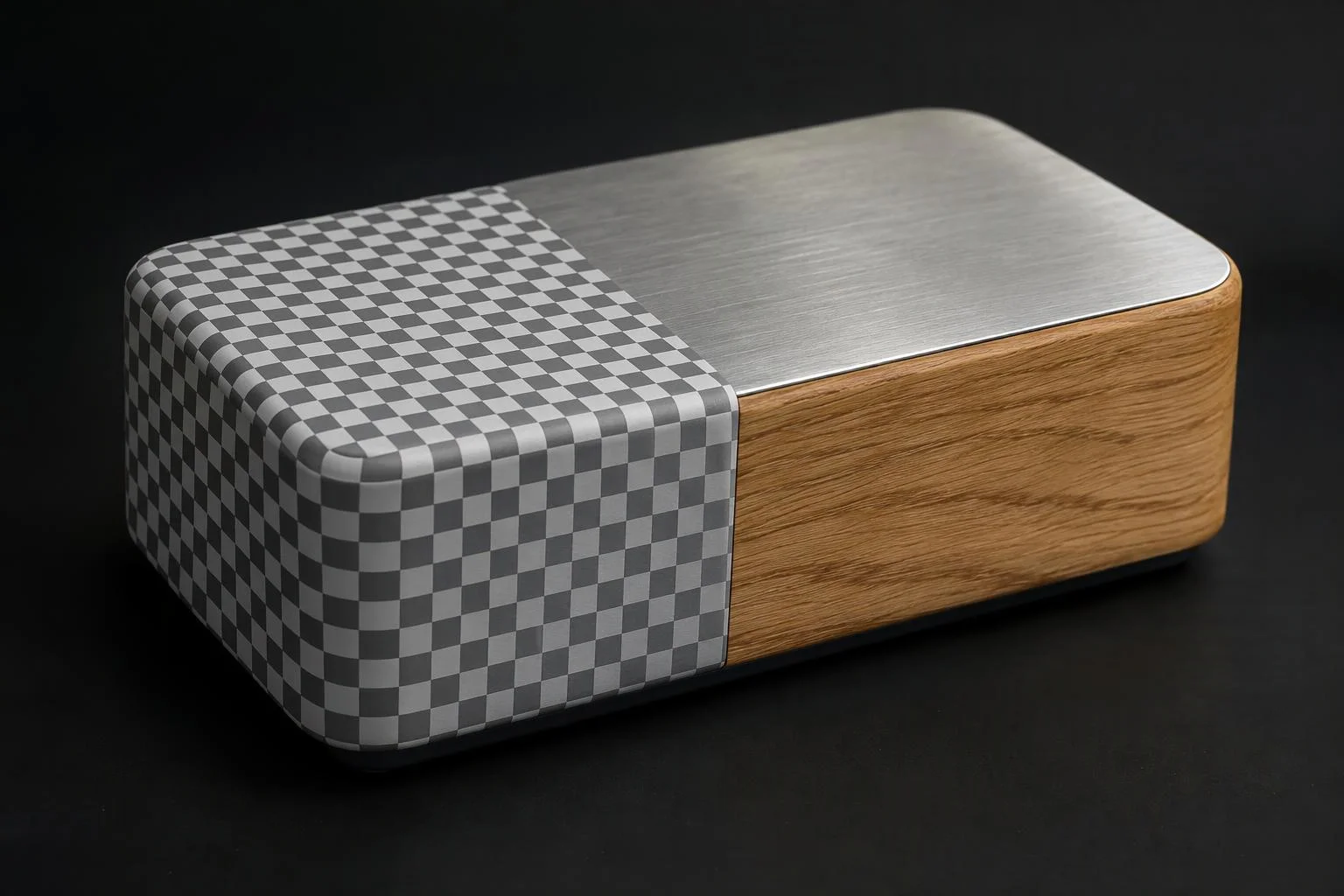
Preserving surface textures and geometric integrity at any size
Generating **made-to-measure 3D meshes** coordinates arc-length UV math with automatic corner clamping so extreme customer inputs never stretch woodgrain or tear a mesh.
Keep woodgrain, stone, and brushed metal at true physical scale
When a tabletop expands from 48 inches to 96 inches, the grain pattern must flow naturally across the longer span and around every filleted edge rather than stretching to twice its width. Aircada calculates UV coordinates on all six faces using true physical arc length across both flat spans and quarter-circle corner arcs.
Automatic radius clamping and clean live geometry rebuilds
Shoppers experimenting with sliders will eventually pair a large corner bevel with a narrow panel width. Built-in per-axis corner radius clamping restricts every fillet to at most half of the shortest active dimension, preventing overlapping vertices or inverted reflections while keeping browser performance smooth.
| Dimension Behavior | Naive 3D Mesh Scaling | Aircada Parametric Regeneration |
|---|---|---|
| Corner Bevels & Fillets | Stretches circular fillets into flattened ovals whenever width and depth scale unevenly. | Scale-compensated rounded box math preserves true circular bevel profiles at every size. |
| Woodgrain & Material Scale | Smears textures linearly across long panels and pinches grain around curved edges. | Arc-length UV calculation maps flat spans and quarter-circle arcs smoothly on all six faces. |
| Extreme Narrow Inputs | Produces self-intersecting corners or inside-out faces when bevels exceed panel thickness. | Per-axis clamping caps every radius at half the shortest side so meshes stay watertight. |
| Curve Smoothness | Fixed polygon count looks jagged when scaled large or wastes memory when scaled small. | Configurable primary (1 to 300) and radial (2 to 300) segments balance detail and speed. |
| 3D Asset Maintenance | Forces teams to model and maintain dozens or hundreds of pre-exported size variants. | One parametric primitive replaces an entire matrix of static GLB size files. |
| Pricing & Order Handoff | Visual scale transforms stay disconnected from linear-foot pricing and fabrication specs. | Same width, height, and depth inputs drive live pricing formulas and checkout line-item specs. |
Responsibility Tiers
- 1 Native Aircada layer
- 1 Aircada Configuration layer
- 1 Custom Implementation layer
- 1 External layer
Responsibility Boundaries Across Parametric Product Sizing
How Aircada's procedural geometry engine, Studio operator bindings, and merchant fabrication specs divide responsibilities.
Procedural primitive generation, arc-length UVs & radius clamping
- Native Aircada
- Real-time browser geometry synthesis for rounded boxes and ten parametric primitives, including scale-compensated corner fillets, arc-length UV calculation, per-axis radius clamping, and discrete-change rebuilds.
Shape type, segment density & dimensional slider bindings
- Aircada Configuration
- Configured in Aircada Studio by selecting from ten parametric shape primitives, setting min/max slider ranges, choosing per-axis corner radii, and wiring operator inputs.
Multi-part parametric assemblies & derived joinery math
- Custom Implementation
- Coordinating multiple parametric meshes (such as stiles, rails, and glass infills that resize together with offset math) using Studio arithmetic operators and custom UI controls.
Tooling minimum/maximum envelopes & raw stock sheet limits
- External
- Your physical CNC bed size, raw material sheet dimensions, and minimum machinable wall thicknesses that dictate the min/max bounds you configure in Studio.
Frequently Asked Questions
How is parametric sizing different from scaling a 3D model on the X, Y, or Z axis?
How do we prevent shoppers from ordering made-to-measure dimensions our shop cannot build?
Which 3D shapes can be generated procedurally without uploading a CAD file?
Can custom dimensions drive live square-foot or volume pricing?
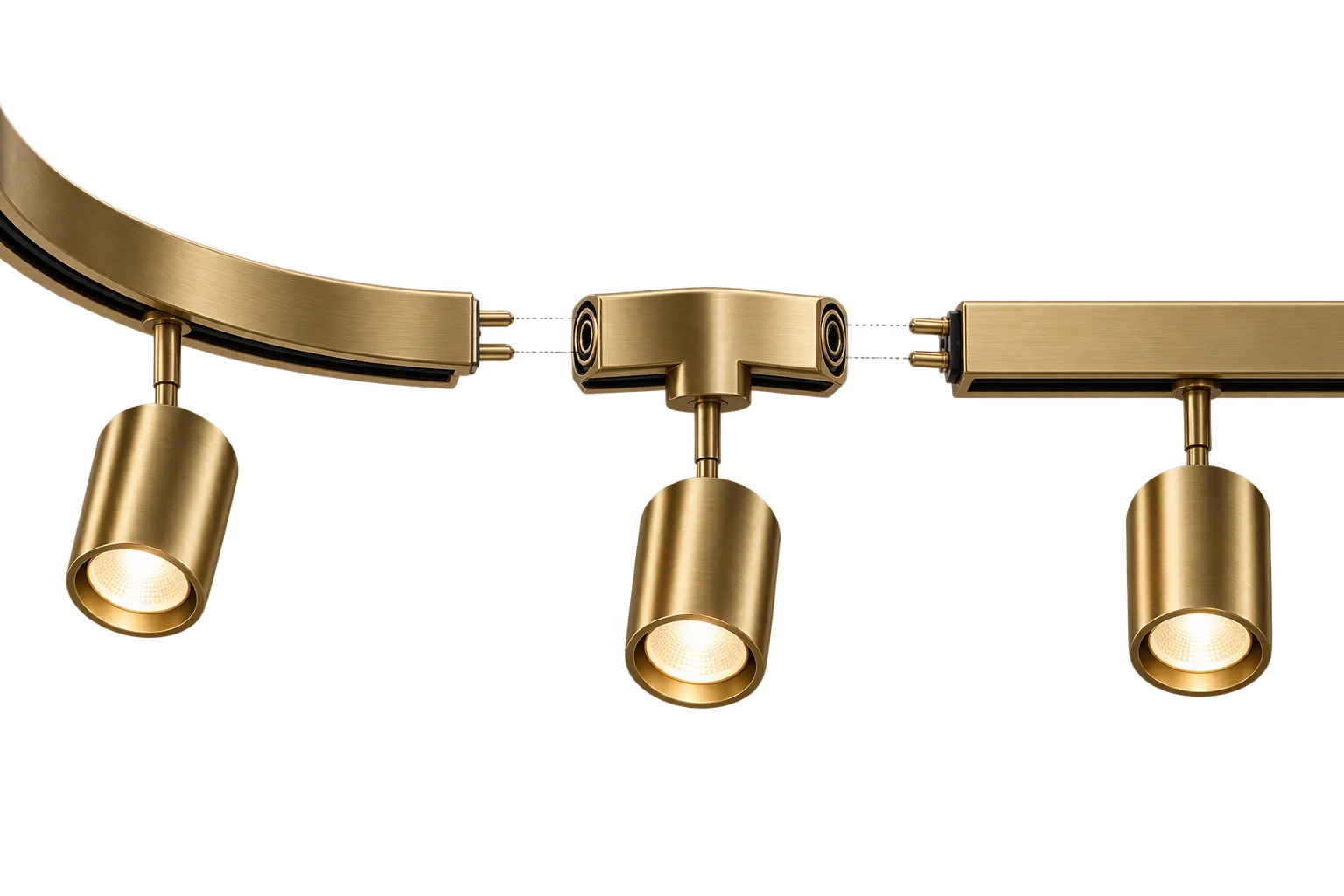
Connect parametric parts into snapping modular assemblies
Combine custom-sized extrusions with port-to-port magnetic snapping and chain solvers for multi-part system builders.
Related capabilities
Explore the adjacent capabilities and integrations that pair with this workflow.
Snap-together modular 3D product assemblies
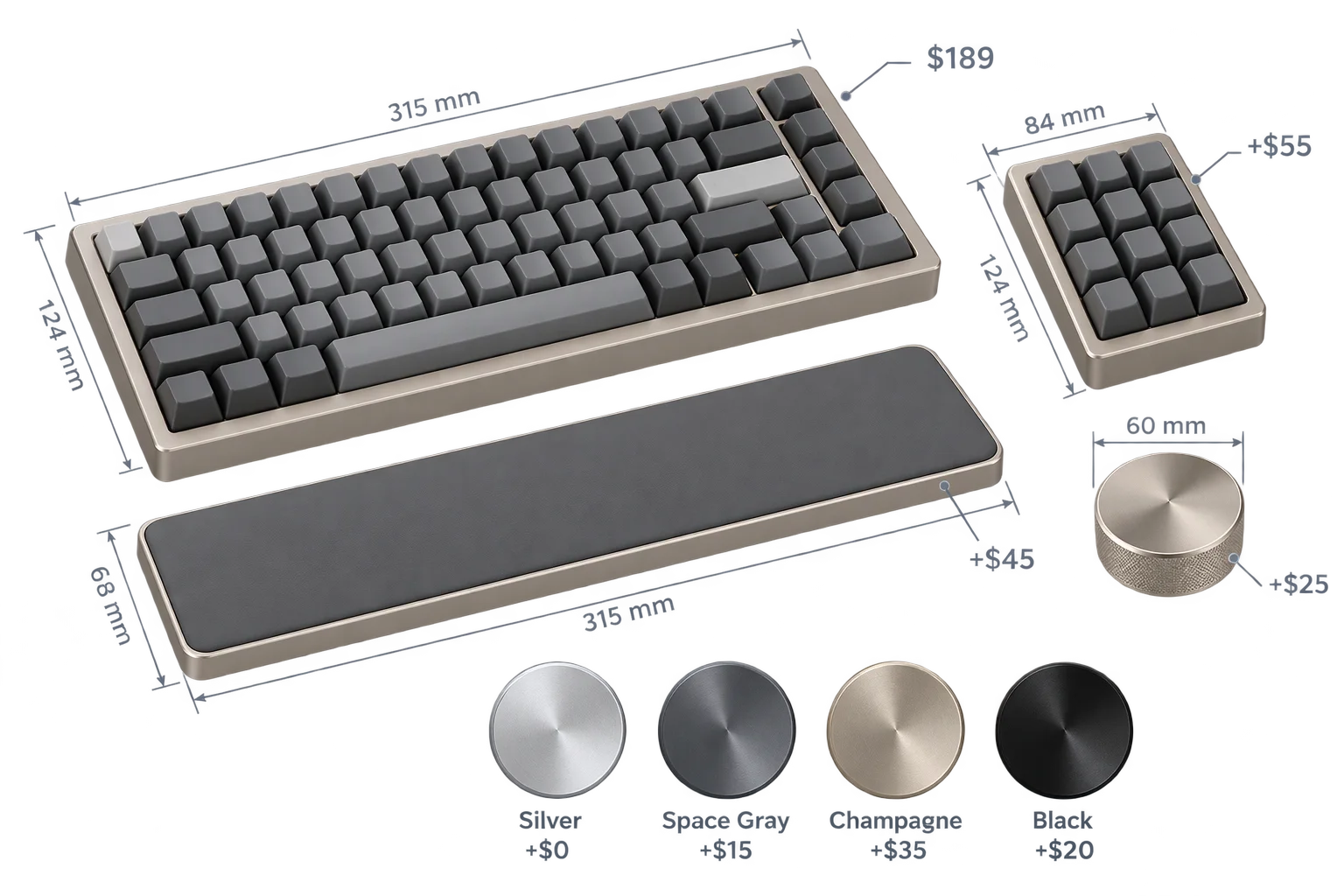
Live dynamic pricing and wholesale quantity breaks
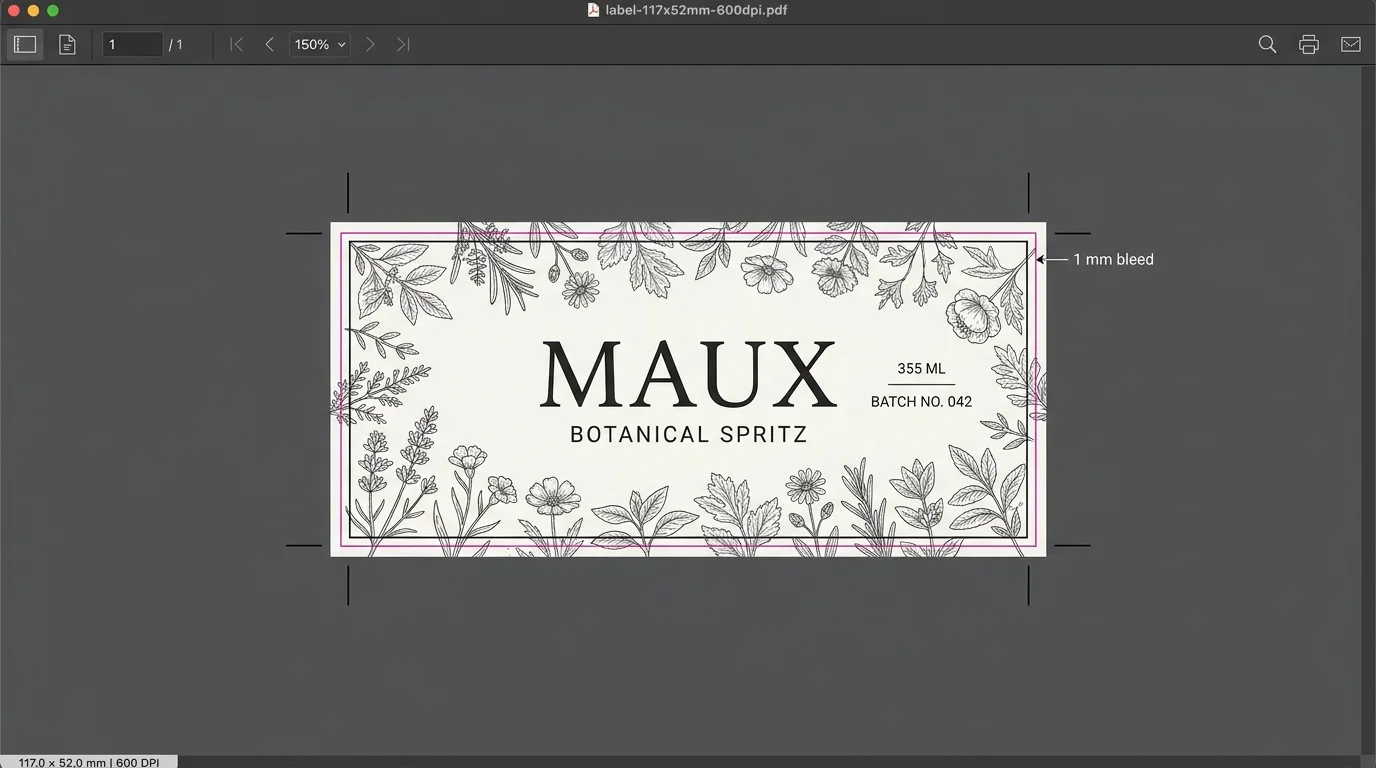
Turn customer designs into print-ready PDFs